

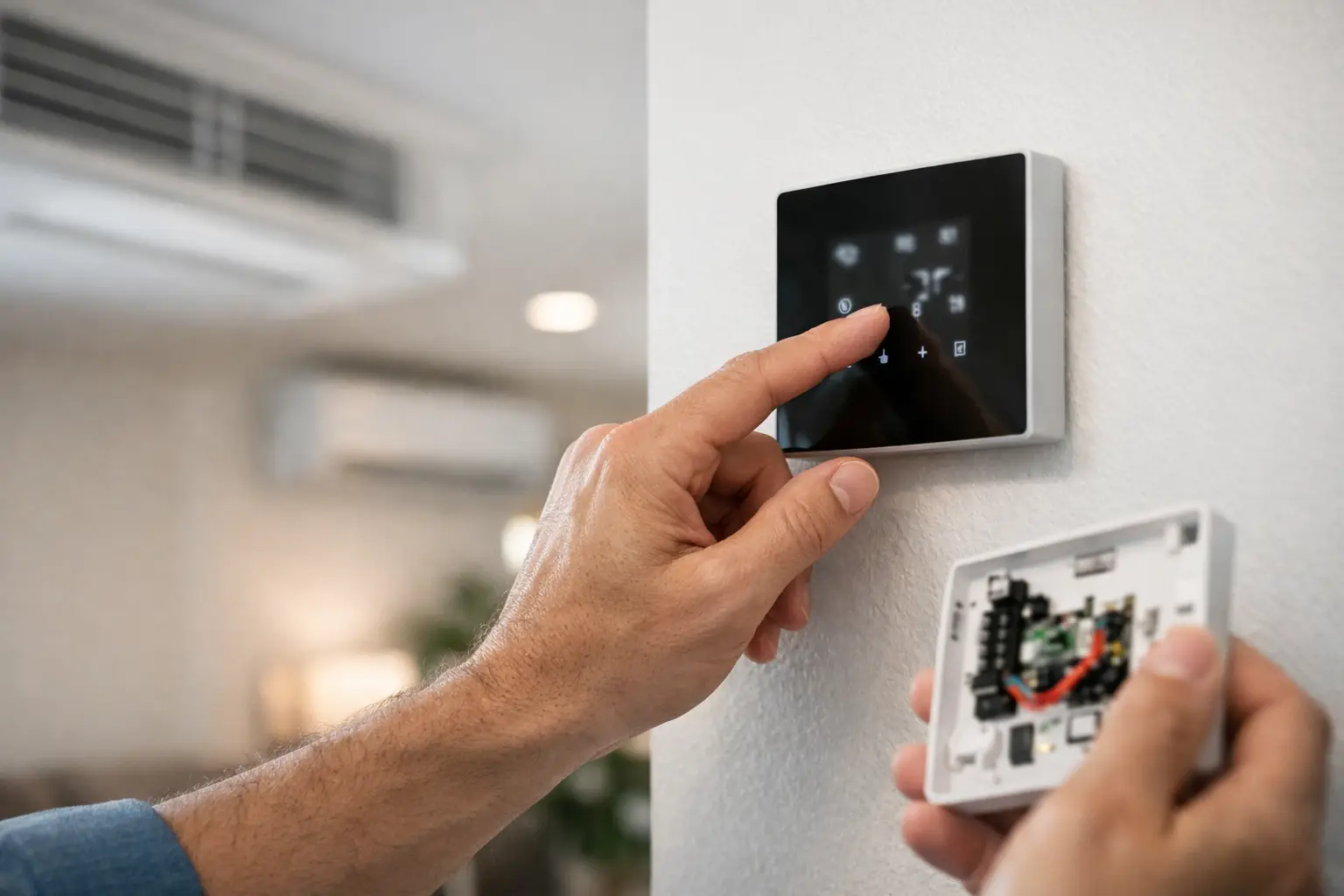
When an AC thermostat not working problem appears in a Dubai villa, the symptoms can feel immediate: rooms become stuffy, the unit will not start, or the AC keeps running without reaching the set temperature. Before assuming the entire system has failed, check the thermostat and a few simple settings. A small issue such as dead batteries, a tripped breaker, or the wrong operating mode can sometimes be resolved quickly. Other signs point to a fault that needs an AC technician.
Start With the Thermostat Settings
A thermostat can look normal while being set in a way that prevents cooling. Set the mode to Cool, not Fan or Heat, then lower the target temperature by 3 to 5 degrees below the current room temperature. For example, if the room reads 79°F, set the thermostat to 72°F and wait a few minutes.
Check the fan setting as well. In most homes, Auto is the best everyday setting because the fan runs only when the AC is actively cooling. If it is set to On, air may continue moving through the vents even when the cooling cycle has stopped. That can make it seem as though the AC is running but not cooling.
If you use a programmable or smart thermostat, review the schedule. A vacation setting, timed temperature change, or app adjustment can override the temperature you expect. This is particularly easy to miss in busy family homes where more than one person has access to the controls.
AC Thermostat Not Working? Check Its Power Supply
A blank thermostat screen usually means a power issue, though not always. If the thermostat uses batteries, replace them with new batteries rather than moving batteries from another device. Ensure they are fitted in the correct direction and that the battery contacts are clean.
For a wired thermostat, check whether the circuit breaker for the AC system has tripped. Reset a tripped breaker once by switching it fully off and then back on. If it trips again, leave it off and arrange professional help. Repeated tripping can indicate an electrical fault, a problem with the AC equipment, or wiring that should not be handled as a DIY repair.
Some central AC systems have a safety switch connected to the condensate drain. When the drain line backs up, the switch may stop the system to prevent water damage. In that situation, the thermostat may lose power or appear unresponsive even though the thermostat itself is not the root cause.
Look for Signs the Thermostat Is Reading the Room Incorrectly
A thermostat relies on its own room-temperature sensor. If it is installed near a sunny window, kitchen heat, a frequently opened exterior door, or a supply vent, the reading can be inaccurate. It may shut cooling off too soon or call for cooling longer than needed.
Compare the thermostat reading with a separate indoor thermometer placed nearby, away from direct sunlight and vents. A small difference is normal. A persistent difference of several degrees may mean the thermostat needs calibration, relocation, or replacement.
Dust can also affect older thermostats. Turn off power to the AC at the breaker before gently cleaning around the thermostat with a soft, dry brush. Do not spray cleaner into the unit or touch the internal wiring. Modern digital thermostats are usually sealed, and opening them can create a larger problem.
The Thermostat May Not Be the Actual Problem
A working thermostat can still be unable to start cooling if another part of the AC system has failed. This matters because changing the thermostat without a proper diagnosis may cost time and money while leaving the real fault unresolved.
If the thermostat display is on and you hear a click when lowering the temperature, it is likely sending a call for cooling. The fault may instead involve the outdoor unit, capacitor, contactor, control board, compressor, or refrigerant system. Weak airflow can also make a home feel warm even when the system is operating.
Start by checking the return-air filter. A heavily clogged filter restricts airflow, makes the system work harder, and can contribute to freezing at the indoor coil. Replace a dirty disposable filter with the correct size and type. If you find ice on refrigerant lines, water around the indoor unit, burning smells, or unusual electrical buzzing, turn the AC off and schedule a technician rather than continuing to run it.
When the AC Turns On and Off Too Often
Short cycling happens when the AC starts, stops, and restarts in quick intervals. The thermostat can be responsible if it is in a poor location or has a faulty sensor, but it is only one possibility. An oversized system, dirty coil, refrigerant issue, electrical fault, or drainage safety switch can cause similar behavior.
Avoid repeatedly changing the temperature setting in an attempt to force longer cooling cycles. That does not fix the cause and may put more strain on the equipment. Note how often the system starts and stops, whether the outdoor unit runs, and whether the thermostat shows any error code. Those details help a technician narrow down the issue faster.
Simple Checks That Are Safe for Homeowners
Before booking a repair, it is reasonable to check the thermostat mode, setpoint, batteries, AC breaker, and air filter. You can also make sure the thermostat panel is securely attached to its base if it is a removable model.
Do not remove the thermostat from the wall to test wires, bypass safety switches, open the electrical panel beyond resetting a breaker, or attempt to add refrigerant. AC controls carry electrical risk, and incorrect wiring can damage the thermostat, control board, or entire system. In a villa, one AC issue may also affect more than one zone or air handler, so a quick professional assessment can prevent a minor fault from becoming a more disruptive repair.
When to Arrange AC Thermostat Repair
Book a technician if the thermostat is blank after fresh batteries and a breaker check, the screen displays an error message, the unit ignores temperature changes, or the system trips the breaker again. You should also arrange service if the AC runs but blows warm air, has weak airflow, leaks water, makes new noises, or cannot maintain a comfortable temperature.
For renters, it is useful to document the thermostat display, the room temperature, and any visible water or error codes before contacting your landlord or maintenance provider. Homeowners and landlords can ask for a diagnosis that covers both the thermostat and the connected AC components. This helps avoid replacing a control when the actual issue is a blocked drain, electrical component, or airflow restriction.
Preventing Repeat Thermostat Problems
Thermostat issues are often easier to prevent than to repair. Replace batteries before they fail, keep the area around the thermostat clear, and change filters on a regular schedule suited to your household and usage. Dubai's long cooling season means AC systems run hard, especially in occupied villas, so annual or planned preventive servicing can catch drain, electrical, and airflow problems early.
If your thermostat keeps failing or gives inconsistent readings, ask whether a compatible replacement is worthwhile. A basic thermostat may be the practical choice for a simple system, while a programmable model can help households manage cooling around work, school, and travel schedules. The right option depends on your AC setup, zoning, and how much control your household actually needs.
A thermostat problem does not always mean a major AC failure, but it should not be ignored during hot weather. If the straightforward checks do not restore cooling, Homes Done Right can help residents in Al Qudra communities arrange a clear diagnosis and reliable same-day AC support.